

Recently, US health regulators (the Food and Drug Administration, FDA) green‑lit a new treatment for adults with familial chylomicronaemia syndrome (FCS), a rare and often devastating genetic disease. For people who face this condition every day, the decision represents more than just a new drug on the market. It offers real hope for a life with fewer crises, less fear, and more normality.
FCS is caused by inherited mutations (most commonly affecting the enzyme lipoprotein lipase, or LPL) that impair the body’s ability to break down certain fats carried in the blood called chylomicrons.
As a result, affected individuals often have dangerously high triglyceride levels, sometimes above 880–1,000 mg/dL (much higher than the normal range). This can lead to frequent, severe episodes of acute pancreatitis, chronic abdominal pain, digestive problems, fatigue, “brain fog,” and other complications like diabetes or liver issues.
The condition imposes a heavy daily burden: many patients must follow a very strict, extremely low-fat diet (often less than 15−20 g of fat per day), avoid alcohol and simple sugars, and live with a constant risk of sudden, life-threatening pancreatitis.
Because of its rarity and severity, FCS has historically lacked targeted treatments; a reality that has long left patients and physicians frustrated and anxious.
The newly approved therapy works by silencing a gene that produces a protein called apolipoprotein C-III (apoC-III). In people with FCS, apoC-III contributes to the accumulation of triglyceride-rich chylomicrons by slowing down their clearance from the blood. By reducing the production of apoC-III in the liver, the drug enables much faster breakdown and removal of these fat particles, helping to bring triglyceride levels down dramatically and sustainably.
In a pivotal clinical trial, patients receiving the drug saw a median reduction of around 80% in triglyceride levels, and, more importantly, a significant reduction in the risk of acute pancreatitis, a life-threatening complication.
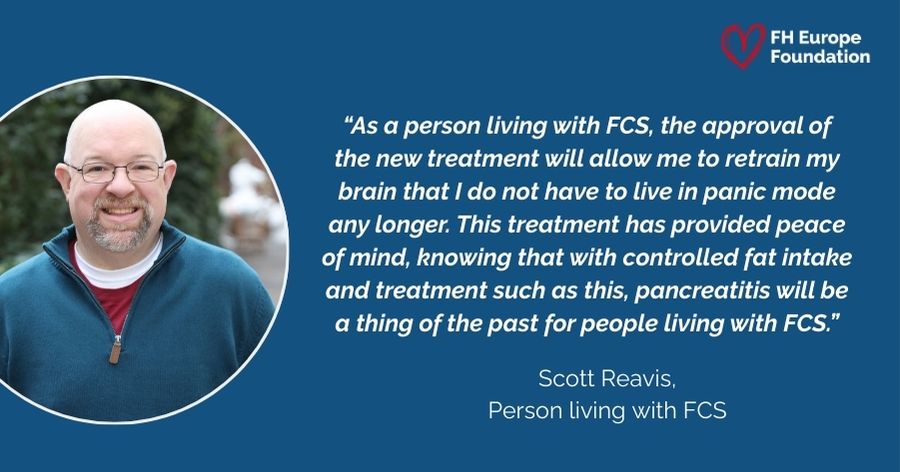
For people living with FCS, these results could be life-changing. The prospect of fewer hospitalisations, fewer pancreatitis attacks, and a more manageable everyday life could lift a heavy burden. For many families, this approval brings hope for a future that feels closer to normal.
Beyond the numbers, the psychological and social impact may also be profound. Patients often describe FCS as invisible to others but ever-present in their daily lives, with diet restrictions, fear of flare-ups, and anxiety about long-term health. This new therapy could offer relief not only to the body, but also to the mind.
While this approval marks a major advance, it does not eliminate all challenges. The treatment is intended as an adjunct to diet, not a replacement for healthy eating and lifestyle adjustments.
Moreover, long-term real-world experience remains to be gathered: how the therapy performs over many years, how accessible and affordable it will be to patients worldwide, and how individuals will adapt their lives around it.
Still, for a community that has long endured uncertainty, severe restrictions, and life‑threatening crises, this represents a turning point. It is a message that science can, and does, deliver hope.
Read the official press release here.
(this announcement contains information originally published by Arrowhead Pharmaceuticals. We are sharing it for general awareness because it may be relevant to people affected by FCS. This link directs to external content created by Arrowhead Pharmaceuticals and sharing it does not imply endorsement of any product, treatment, or organisation.)
Prepared by
 Dr. Marina Leroy,
FH Europe Foundation Scientific Communications Manager