
On 31 May 2026, the PERFECTO project officially came to an end after 30 months of collaboration dedicated to advancing paediatric screening for Familial Hypercholesterolaemia (FH) across Europe. Coordinated by FH Europe Foundation and co-funded by the EU4Health Programme, PERFECTO was built around a clear public health ambition: to support the early detection of FH in childhood, strengthen cardiovascular prevention, reduce health inequalities, and help health systems move from awareness to implementation.
From the outset, PERFECTO was designed to explore how familial hypercholesterolaemia can serve as a model for innovation in cardiovascular prevention. By bringing together scientific evidence, personalised communication, health equity, health economics, patient engagement and policy development, the project developed practical tools and recommendations that can support discussions on the implementation of paediatric FH screening programmes across Europe.
For me, PERFECTO has been much more than a project. It has been a journey of turning lived experience, scientific evidence and patient leadership into a shared European call for action. It showed that preventing cardiovascular disease starts much earlier than we often think — with awareness, early diagnosis, family empowerment and equitable access to paediatric FH screening. I am proud that PERFECTO helped move FH from being an under-recognised inherited condition to a stronger part of Europe’s prevention agenda. The project may have ended, but the responsibility to prevent the preventable continues. Magda Anthousi, FH Europe Foundation
Familial hypercholesterolaemia is one of the most common inherited conditions, affecting approximately 1 in 300 people, yet an estimated 90% of those affected remain undiagnosed. Children with FH are exposed to elevated LDL cholesterol from birth. Without timely diagnosis and management, this lifelong exposure can significantly increase the risk of premature cardiovascular disease, often decades earlier than in the general population.
The encouraging news is that FH is also one of the most actionable inherited cardiovascular conditions. When identified early, children can benefit from lifestyle guidance, regular follow-up and, where appropriate, lipid-lowering treatment that can substantially reduce their long-term cardiovascular risk. Importantly, diagnosing one child often leads to the identification of other affected relatives through cascade screening, enabling parents, siblings and extended family members to receive appropriate care. A single diagnosis can therefore benefit multiple generations, making paediatric screening a powerful strategy for preventing inherited cardiovascular disease.
Throughout the project, PERFECTO brought together researchers, clinicians, patient representatives, healthcare professionals, policymakers and communities to explore what is needed to make paediatric FH screening more accessible, acceptable and sustainable across diverse European healthcare systems.
One of the project's defining achievements was the development and piloting of the Personalised Communication Model (PCM). The PCM was built on a simple but powerful principle: successful screening programmes depend not only on scientific evidence and diagnostic technologies, but also on how people receive, understand and act upon health information. PERFECTO recognised that participation in screening is strongly influenced by trust, health literacy, cultural context, family dynamics and people's confidence in navigating healthcare systems. Communication is therefore not an “add-on” to screening — it is one of its essential components. Adopting a person-centred, bottom-up approach, the PCM was designed to help healthcare professionals and public health authorities communicate more effectively with families and communities, improve informed decision-making and strengthen long-term engagement with screening programmes.
Another important contribution of PERFECTO was its work around the societal return on investment (sROI) of paediatric FH screening. While the clinical benefits of early diagnosis are well recognised, PERFECTO explored the wider societal value of prevention, including potential reductions in future cardiovascular events, healthcare costs, productivity losses and the broader benefits created through cascade screening of families. The project helped highlight that investing in early detection can create value beyond the individual patient. Earlier diagnosis may support healthier families, more efficient use of healthcare resources and stronger prevention-oriented health systems over the long term. As European countries increasingly seek robust evidence to support preventive healthcare policies, understanding this broader societal value is essential for the sustainable implementation of screening programmes.
Putting health equity at the heart of implementation
Health equity was another defining pillar of PERFECTO. Through its Health Mediation Assessment, the project examined how structural barriers, social determinants of health, health literacy, trust in healthcare systems and continuity of care influence access to paediatric FH screening, diagnosis and follow-up.
Drawing on evidence from Romania, Cyprus and examples from across Europe, PERFECTO explored how community-based health mediation can improve participation in screening programmes, particularly among underserved and marginalised populations. These findings highlighted that equitable screening cannot rely solely on clinical recommendations. Successful implementation also requires trusted local engagement, culturally appropriate communication and healthcare systems capable of reaching those who are too often left behind. By linking these findings with both the PCM and the sROI model, PERFECTO reinforced the importance of addressing health equity and prevention together as part of effective public health implementation.
Throughout the project, PERFECTO focused on producing practical outputs that can continue supporting implementation after the project’s completion.
Among its major achievements were:
Together, these achievements provide a strong foundation for countries wishing to develop or expand paediatric FH screening programmes.
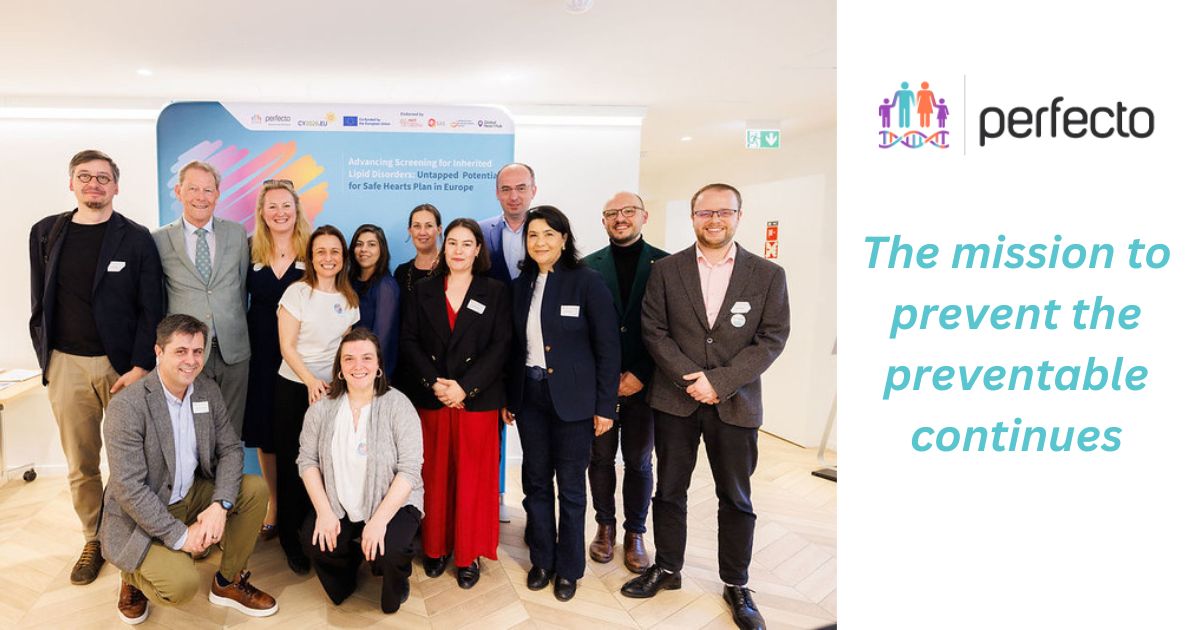
Rather than marking only the end of the project, the PERFECTO Closing Event, held on 27–28 April 2026 in Brussels under the auspices of the Cyprus Presidency of the Council of the European Union, looked firmly towards the future. The event brought together more than 270 participants from 69 countries, including policymakers, researchers, clinicians, patient organisations and representatives of European institutions.
Across two days of discussions, participants explored how the project’s evidence and tools can support further action on paediatric FH screening throughout Europe. Sessions highlighted the project’s scientific achievements while addressing broader themes including personalised communication, health equity, health economics, patient engagement and policy development. Importantly, the meeting reinforced that Europe already possesses much of the scientific knowledge needed to improve early detection of inherited lipid disorders. The next challenge is implementation — translating evidence into sustainable national policies, integrated care pathways and equitable access to screening.
One of PERFECTO’s important achievements has been helping to strengthen the visibility of paediatric FH screening within the European cardiovascular prevention agenda. Throughout the project, partners engaged with policymakers, clinicians, researchers, patient organisations and public health experts to show that successful implementation requires coordinated action across multiple sectors. A major policy milestone was the explicit reference to both Familial Hypercholesterolaemia and PERFECTO within the Safe Hearts Plan, reflecting the growing recognition of inherited lipid disorders and paediatric screening within Europe’s evolving cardiovascular health strategy. The project has also contributed to broader discussions around prevention, citizen engagement, health equity and personalised healthcare, helping support a shift from treating cardiovascular disease to preventing it before it develops. A lasting legacy
The communication tools, scientific evidence, policy recommendations and collaborative networks developed through the project can continue supporting advocacy, implementation and future European initiatives focused on inherited lipid disorders and cardiovascular prevention. PERFECTO has shown that effective paediatric screening is about much more than measuring cholesterol. It is about empowering families, reducing inequalities, strengthening prevention, supporting informed decision-making and ensuring that every child has the opportunity to benefit from early diagnosis and lifelong cardiovascular health.
Perhaps most importantly, the project has reinforced that preventing premature cardiovascular disease begins long before symptoms appear. By combining scientific evidence, health economics, personalised communication, health equity, patient leadership and policy engagement, PERFECTO has laid important foundations for the future implementation of paediatric FH screening across Europe. Its legacy extends beyond Familial Hypercholesterolaemia. The principles developed through PERFECTO — early detection, personalised prevention, meaningful patient engagement, health equity and evidence-informed policymaking — can inform future approaches to other non-communicable diseases.
As highlighted throughout the project, the challenge is no longer simply generating evidence. It is ensuring that this evidence reaches policymakers, healthcare professionals and communities, and is translated into sustainable screening programmes that improve lives. FH Europe Foundation warmly thanks all PERFECTO partners, experts, patient ambassadors, healthcare professionals, policymakers and stakeholders who contributed to this remarkable journey.
The project may have reached its conclusion, but the mission remains unchanged: Prevent the Preventable.