

Familial hypercholesterolaemia (FH) affects millions of people worldwide, yet too many remain undiagnosed, undertreated, or unable to access the care they need. Established in 2015, the EAS-FH Studies Collaboration (FHSC) is a global initiative that brings together clinicians, researchers, and patient organisations from around the world to better understand FH and improve outcomes for everyone affected by the condition. As a proud partner of the EAS-FHSC, FH Europe Foundation helps ensure that the patient's perspective remains at the heart of this global effort.
For many patients, registries can seem distant or highly technical. In reality, registries are one of the most powerful tools we have to improve care. By securely collecting information from thousands of people living with FH, researchers can better understand:
Every data point contributes to a bigger picture that can help shape future care, guidelines, research priorities, and health policy.
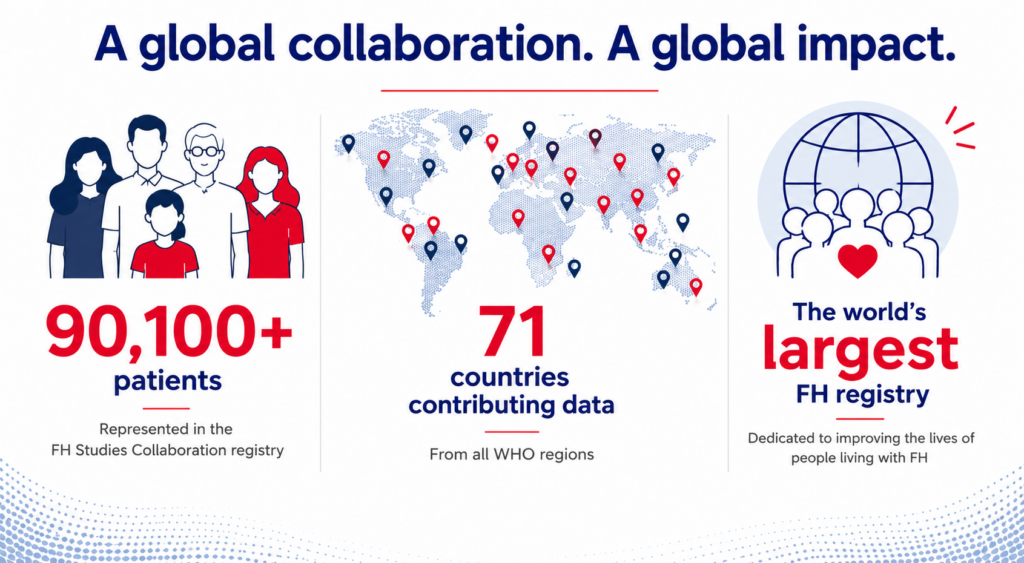
Today, the registry includes data from more than 90,000 individuals living with FH across 71 countries, making it the largest and only international FH registry ever assembled. The registry continues to grow every year, expanding its reach and strengthening our understanding of FH across different regions and healthcare systems.
Utilising this unique resource, the FHSC has explored several key determinants of cardiovascular risk in individuals with FH, including their diagnosis, care, cholesterol target attainment, and other risk factors beyond high cholesterol, such as obesity, diabetes and Lp(a).
The strength of the FHSC lies not only in the size of its registry, but also in its ability to translate real-world data into evidence that improves patient care. Research generated through the FHSC has informed scientific publications, clinical guidelines, and international discussions on inherited lipid disorders. At FH Europe Foundation, these findings also support our advocacy and policy work, helping us promote earlier diagnosis, equitable access to care, and evidence-based decision-making across Europe and beyond.
Watch these videos to learn how the EAS-FH Studies Collaboration is helping transform the understanding and management of FH worldwide.
The data collected through the registry have already revealed important insights.
These findings reinforce what patients have long known: earlier diagnosis and equitable access to care can change lives.
At FH Europe Foundation, we believe that research should not only be about patients—it should be conducted with patients.
Our partnership with the EAS-FH Studies Collaboration (FHSC) ensures that the patient voice is embedded throughout the collaboration, helping shape research priorities and translating evidence into meaningful improvements in care.
As part of our Memorandum of Understanding with the EAS-FHSC, FH Europe Foundation holds a permanent seat at the annual FHSC Steering Committee Meeting, where we contribute the patient perspective alongside leading clinicians and researchers from around the world. We also meet regularly with the FHSC Coordinating Team to strengthen collaboration and identify new opportunities to advance patient-centred research.
Together, we work to:
Our partnership has also led to practical resources for the community, including the Find My Lipid Clinic directory, which helps people living with inherited lipid disorders locate specialist lipid clinics and patient organisations worldwide.
By connecting researchers, healthcare professionals and people with lived experience, we help ensure that data is transformed into knowledge—and that knowledge into better care.
The true value of a registry is not the number of patients it contains. Its value lies in what it enables. Every new country that joins, every clinic that contributes data, and every patient represented helps build a stronger evidence base for:
As new therapies emerge and the understanding of FH continues to evolve, international collaborations such as EAS-FHSC will play an increasingly important role in shaping the future of care.
The EAS-FH Studies Collaboration demonstrates what is possible when researchers, healthcare professionals, and patient organisations work together.
FH Europe Foundation is committed to supporting and expanding these types of collaborations—not only through EAS-FHSC, but also through future registries, research projects, and international initiatives that place patients at the centre.
Because better data leads to better evidence. And better evidence leads to better lives.
Whether you are a researcher, clinician, patient organisation, policymaker, or industry partner, we welcome opportunities to support patient-centred research that advances the diagnosis, management, and care of inherited lipid disorders.
To explore potential collaborations with FH Europe Foundation, please send us an email at info@fheurope.org.