
As FH Awareness Day approaches, the FH Europe Foundation community is connecting local action with a powerful policy moment for early detection and prevention.
Every minute, somewhere in the world, a child is born with familial hypercholesterolaemia (FH). Each birth is another opportunity for early detection and lifelong prevention, but only if health systems, professionals, families and communities know to look for FH.
That sense of urgency and possibility was at the heart of two FHEF community calls held in August. Convened to prepare for FH Awareness Day on 24 September, the calls became a lively global exchange of practical ideas, national progress, policy intelligence and mutual support.
Participants joined from across Europe and countries including China, Iraq and Thailand, while updates extended further into Africa and Asia. The message was clear: FH Awareness Day is not only a moment to explain what FH is. It is an opportunity to help people understand their risk, know what to do next and turn awareness into action.
This year’s campaign arrives against an important policy background in Europe. The EU Safe Hearts Plan recognises FH and inherited lipid disorders within Europe’s cardiovascular prevention agenda and places renewed emphasis on early detection.
The European Commission’s work on recommendations for cardiovascular health checks offers a further opportunity to ensure that cholesterol, family history and inherited risk are systematically considered.
The timing matters. FH causes elevated LDL cholesterol from birth. Identifying it only in midlife means losing years during which premature cardiovascular disease could have been prevented. The community’s call is therefore not simply for more screening, but for screening early enough to change lives.
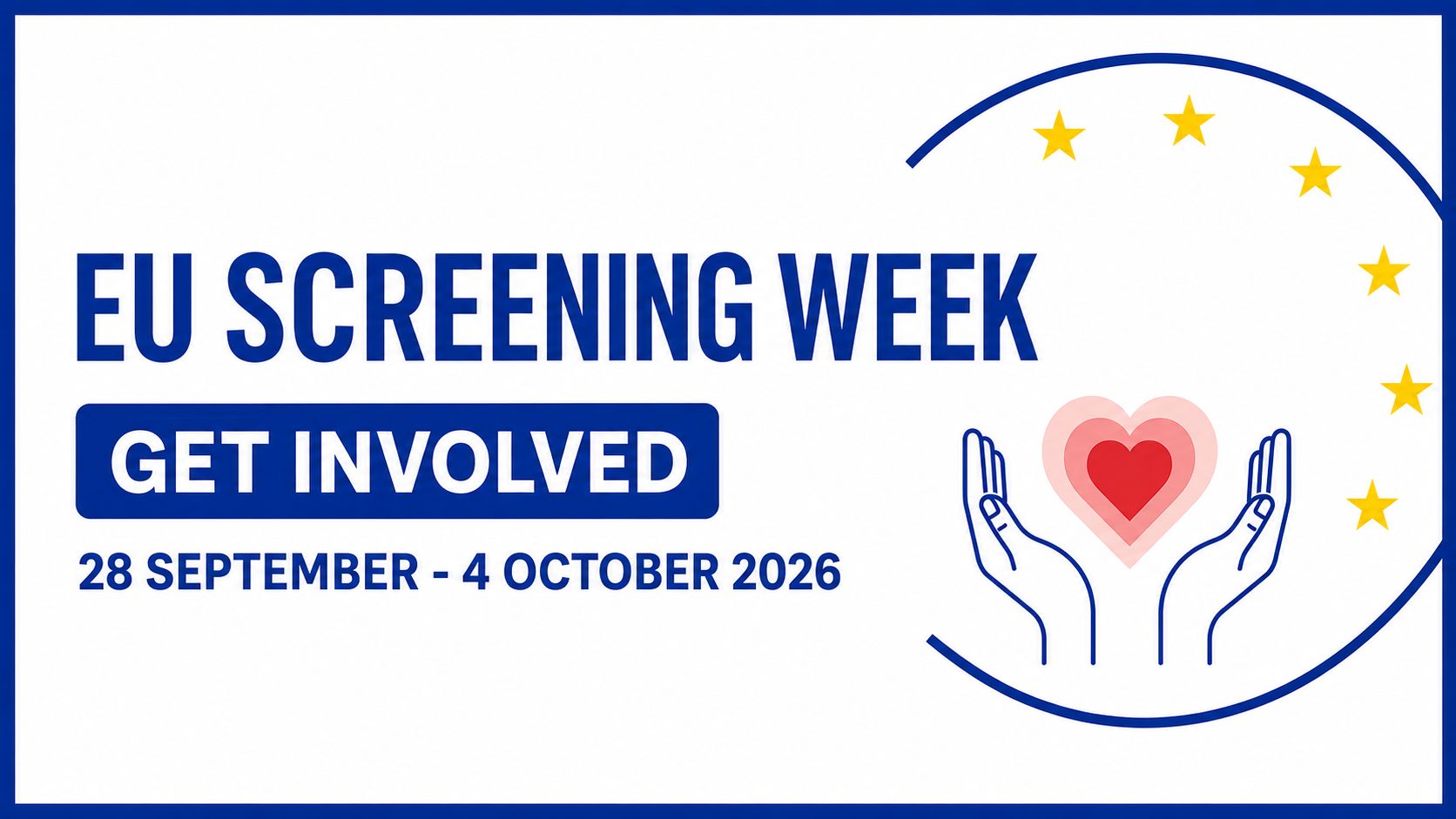
The first-ever EU Screening Week, beginning on 28 September, adds a visible Europe-wide platform for prevention. Testing programmes, educational events, webinars, community outreach and communication campaigns can all contribute. Taking place shortly after FH Awareness Day and alongside World Heart Day, it creates a rare opportunity to connect inherited risk with the broader cardiovascular health agenda.
Progress in France towards systematic FH screening at age six, Austria’s new national lipid consensus, and paediatric screening developments in Luxembourg and Latvia demonstrate how sustained advocacy can translate into policy attention, stronger guidance and practical screening pathways.
One of the most valuable insights from the calls came from members reporting on a previous shared action: writing to national ministries of health about cardiovascular health checks and the inclusion of paediatric FH screening.
Responses have arrived from Ireland, Austria and the Netherlands, helping to reveal where persistent objections remain and which questions must still be addressed to convince policymakers.
A negative or disappointing response is not the end of advocacy. It confirms that the message has reached the decision-maker, exposes the arguments that must be challenged and provides a basis for coordinated follow-up.
By comparing responses across countries, members can identify common barriers, strengthen the evidence behind their asks and make the next approach harder to dismiss. A campaign letter therefore becomes more than a single communication: it opens an accountable policy conversation.
The calls revealed a remarkable range of activities already taking shape. Although countries are working with different health systems, resources and levels of public awareness, each is finding a practical way to advance the same goal.
The community also highlighted the FH Summit in Poland, Croatia’s RUN4FH and an in-person FH Connect event in Singapore. Work is underway to support the development of a patient organisation in South Africa.
These initiatives demonstrate that the movement is not defined by one format or geography. A screening day, policy workshop, scientific meeting, run, video, translation or patient story can all contribute to a shared effort.
Participants did more than report activities. They helped shape how the campaign should communicate.
Patient advocates and experts discussed how to balance hopeful messages with more emotive images showing the consequences of late diagnosis or lack of access. The discussion recognised that one approach will not work for every audience. Children and families may benefit from messages centred on the possibility of a long, healthy future, while adults may sometimes need a more direct reminder that untreated FH can lead to a heart attack at a young age.
This is why the campaign toolkit is designed to be adaptable and representative of different ages, backgrounds and communities. Members offered translation support, shared evidence about which visuals engage their audiences and suggested ways to make the materials more locally relevant.
The 2026 campaign is ultimately about empowerment. It will help people understand cholesterol screening, lipid profiles and laboratory results, cardiovascular and inherited risk, family history, FH management and evolving treatment options.
Personal stories will remain central. People living with FH are invited to share their photograph, age at diagnosis and reflections on why timely screening mattered—or what an earlier diagnosis could have changed. These experiences give policy asks a human face and help others recognise themselves and their families in the message.
What made the August calls powerful was not only the number of activities announced. It was the willingness to learn across borders: a policy response in one country becoming evidence for another; a successful visual inspiring a different audience; clinicians stepping forward where no patient organisation yet exists; and experienced advocates offering their reach to emerging communities.
FH Europe Foundation’s role is to help connect these efforts, make local work more visible and demonstrate to decision-makers that they are not isolated activities but part of a growing global movement.
This FH Awareness Day, our shared task is to make early detection impossible to overlook: know your cholesterol, know your family history, understand your results and act early. When communities connect awareness with evidence, policy and practical action, we do more than mark a date, we help prevent the preventable.