
On 14th April, our youngest patient ambassador, Elisete Poobus (6 years old), along with her family, was invited to the 30th Anniversary conference of the Estonian Phenylketonuria Association, to provide an insight into living with FCS (Familial Chylomicronaemia Syndrome).
Elisete’s mother, Teevi Poobus, gave a short presentation explaining how Elisete was first diagnosed and how they, as a family, dealt with this news. She also spoke about the symptoms associated with FCS, and the strict diet Elisete must follow. Patients with FCS are restricted to a maximum of 20g of fat per day, while for Elisete at 6years old, it’s just 5g!!! This includes ‘good’ fats such as nuts, seeds, avocado, olive oil.
During her presentation, Teevi also gave huge thanks to the healthcare professionals in the hospital that treat Elisete and those who have supported her family on this journey. Teevi said that “although it is Elisete with the diagnosis, it feels like it is my own too”.
There is no patient organisation in Estonia for people with FCS, so the family struggled to find support and had to deal with government bureaucracy alone in an effort to find help.
In 2023 Teevi found FH Europe Foundation, which already had a supportive group of people across Europe and the US living with FCS. In November Teevi and Elisete were invited to Amsterdam for the FH Europe Foundation annual conference, where they were able to unite with other FCS patients. Although Elisete was the youngest among them, she was comfortable with all the attention and rocked her moves on the dance floor!
The positive outcome of Elisete's and her mum's advocacy work at the April meeting has been an offer to help the Poobus family get FCS recognised in Estonia as a condition that needed urgent support. Fingers crossed it works out this time!
Prepared by : Teevi Poobus, FCS Ambassador from Estonia
Today, 24 March, is Lp(a) Awareness Day. Elevated lipoprotein(a), or Lp(a) concentration, is an inherited lipid condition and an independent, very significant risk factor for cardiovascular disease. While elevated Lp(a) levels can be diagnosed through a simple blood test, it is estimated that one in five people have elevated Lp(a) concentrations, significantly increasing their risk for heart attacks and strokes, even at a young age.
Alarmingly, only 1% of the population in middle- and high-income countries have had an Lp(a) measurement and most of those with elevated concentrations are not informed about their increased risk of experiencing a first or recurrent cardiovascular event. There is very little public awareness about this common inherited risk factor, and there is also limited awareness and knowledge among general practitioners (GPs) and the wider healthcare professionals' community.
This presents a crucial missed opportunity for CVD prevention, early detection, the avoidance of costly treatment, care and hospital admissions impacting on the already stretched health systems and the significant burden to individuals and their families across their life course, following a CVD episode.
Given the gravity of elevated Lp(a), FH Europe Foundation set up a dedicated Lp(a) International Task Force in 2023, to develop and implement a five year strategy to address major gaps in policy, awareness, understanding of cost-effectiveness, personalised prevention approaches, and the role of digitalisation and data in encouraging a more comprehensive approach to systematic testing of populations. Professor Florian Kronenberg, Chair of the Task Force said “This Task Force is unique as it is composed of Lp(a) experts and experts from other disciplines from across the globe, to focus on making Lp(a) testing the norm and managing this alongside other risk factors”.
Emma Print, FH Europe Foundation’s Community Engagement Manager has been coordinating activities around the Lp(a) Awareness Day. She said “As a person living with Lp(a) and FH, I am grateful that I was diagnosed relatively early – but I met formidable barriers in the process. I now have the privilege of working with the FH Europe Foundation and to help raise awareness among as many people as possible, today – and indeed all days. We work with Lp(a) Ambassadors, who have the lived experience and knowledge, to share their powerful stories, like the one of Marc’s”.
This year we really wanted to support the community by providing them with the opportunity to “Ask Me Anything About Lp(a)”. Through our social media and email campaign we encouraged members of the public to complete an online form enabling them to ask any question about Lp(a) to our international panel of experts which included researchers, clinicians and people living with elevated Lp(a). The response was tremendous and culminated in a webinar on Thursday 21st March where our experts answered as many of the questions as possible.
The FH Europe Foundation is committed to building awareness- year on year- among the public and physicians on the importance of measuring for Lp(a). A particular feature this year, however, is an Open Letter from the International Task Force to policymakers and, setting it in the context of the wider burden of cardiovascular disease and the urgent need to ‘prevent the preventable’. Magdalena Daccord, FH Europe Foundation CEO said “We are deeply concerned that elevated Lp(a) is largely invisible in the health policy space, and we need to change that. With the International Task Force, we are creating an unprecedented momentum to finally get this on the political radar”.
For press queries, please contact Magdalena Daccord on md@fheurope.org .
More about FH Europe Foundation: https://fhef.org/
More about the Lp(a) International Task Force: https://fhef.org/lpa-international-taskforce/
On the eve of the Lp(a) Awareness Day, we have this personal blog prepared for you by Marc Rijken, one of our Ambassadors and Members of the Lp(a) International Task Force. Marc shares his powerful story and a call to action to get to know more about an invisible risk factor which affects one in five people. But hold on, there is more. You can meet Marc’s family and learn more about their daily life if you open a link to the very immersive article with additional pictures and videos.
Dear all,
Today marks a strange day, as it is exactly 10 years ago that I suffered a (first) heart attack. I know that not all of you are aware, apologies if I gave you a scare. I am currently doing very well and aim to be the fittest heart patient of the Netherlands 😊.
For me, it took 6 very long years and two heart attacks, until the diagnosis and root cause of my heart/artery issues (elevated levels of Lp(a)) was made. By coincidence, my “anniversary” is only 1 day away from the Lp(a) Awareness Day, March 24.
As I am sure most of you are unaware of Lp(a), I thought this was a good time to tell you a little bit about this.
Lp(a) is a lipoprotein and is part of everybody (just like for example cholesterol is). If you however have elevated levels of this protein, you have an increased risk of cardiovascular diseases (heart attacks, atherosclerosis, and related). It is inherited and runs in families, so if your relative, especially parents had or have heart issues, you should be alerted.
Why do we need an Lp(a) Awareness Day, you might think, … here are some reasons:
By sharing this post and attempting to raise knowledge and awareness of Lp(a), I hope to be able to protect others from a similar (patient) experience; time is of the essence! Besides time, knowledge can make the difference, as certain life(style) choices can be made to reduce the risks.
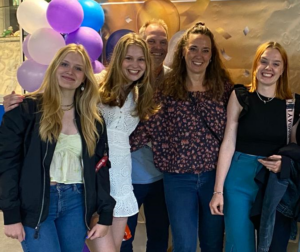
As elevated levels of Lp(a) is genetic, my family was also tested and two of my daughters unfortunately inherited this disorder. This was difficult to accept at first, but currently I am confident that they will be able to live a healthy life (now that they are aware).
Throughout the last 10 years I have learned a great deal about myself, and I look back with pride on the way I (and my family) have coped with this. I have also learned through my role as a Patient Ambassador with FH Europe Foundation, what a difference it can make for others to share our experiences and to interact with other fellow patients.
I could not have imagined the network, projects, webinars, the Global International Lp(a) Taskforce, scientific congresses, partnerships and friendships (hey it even got me into the European Parliament in Strasbourg), which elevated Lp(a) has also indirectly given me (through my ambassadorship).
Which brings me to my first sentence of this post, a strange day, as the journey came with a lot of emotions (such as fear, worry, frustration, anger, and sadness).
You can read all about the impact which elevated Lp(a) has had on me and my family over the past 10 years which has been very well put into words in the following article: https://live.novartis.com/article/family-ties/family-ties-subsection. (Thanks Goran)
Thanks for taking the time for this post - turned into a blog - and please feel encouraged to spread the word (awareness)!
Marc Rijken
Let us know if this story how this story affected you. Are you suspecting elevated Lp(a) in your family? If you need additional information, please contact Emma@fheurope.org.