
We are pleased to welcome Corazón Sin Fronteras to the FH Europe Foundation Network. Based in Vitoria-Gasteiz, Spain, this long-standing cardiovascular health association joins our growing European community dedicated to improving prevention, care, and patient support in cardiovascular disease.
Founded in 2005 and formally registered in the Basque Country, Corazón Sin Fronteras is a non-profit organisation committed to promoting heart health, preventing cardiovascular disease, and supporting patients and families. Their work spans education, prevention, rehabilitation, and community engagement, with activities ranging from public awareness campaigns and cardiovascular health events to patient support initiatives and collaboration with healthcare professionals.
Joining the FH Europe Foundation Network is a natural step for Corazón Sin Fronteras. With a strong focus on prevention, patient wellbeing, and community empowerment, the organisation recognised the value of connecting with a wider European movement advocating for early detection, equitable care, and improved outcomes in inherited lipid conditions and premature cardiovascular disease.
This partnership is built on a shared commitment to:
Corazón Sin Fronteras brings valuable strengths to the network. Their presence enhances representation from Spain and adds important regional, cultural, and linguistic perspectives. Their long-standing experience in prevention and community-based education complements the network’s work in early detection, patient empowerment, and cardiovascular risk reduction.
Their active involvement in initiatives such as World Heart Day, cardiovascular health weeks, peer support activities, and public outreach aligns closely with the FH Europe Foundation’s commitment to community-led health promotion. These shared efforts will reinforce collective visibility, impact, and advocacy at both national and European levels.
Through membership in the FH Europe Foundation Network, Corazón Sin Fronteras will benefit from:
At the same time, the network is strengthened by:
Together, we continue to build a strong, connected European network committed to reducing the burden of inherited and preventable cardiovascular conditions and improving the lives of patients and families across Europe.
Prepared by
 Elsie (Cindy) Evans,
FH Europe Foundation Ambassador Programme Manager
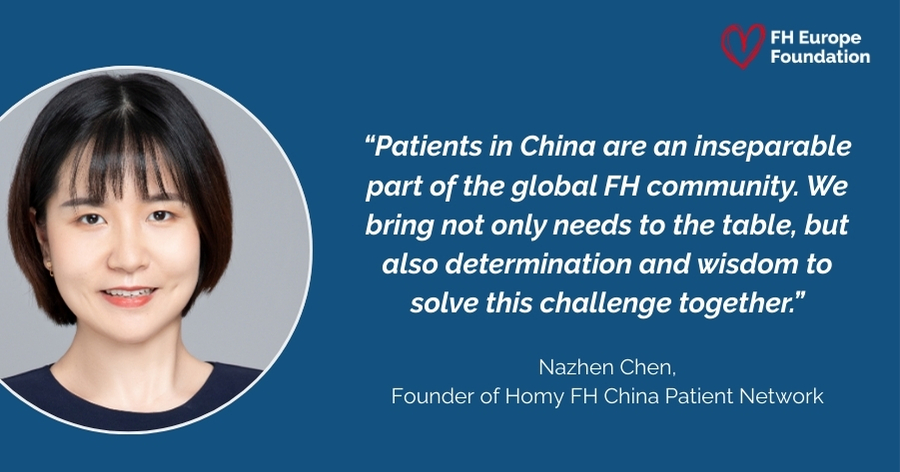
The FH Europe Foundation is delighted to welcome FH China as new member of our international Network. This partnership marks a significant step in amplifying patient voices, strengthening global collaboration, and accelerating progress for communities affected by familial hypercholesterolaemia (FH) and related conditions.
Founded by Nazhen “Jenna” Chen, a heterozygous FH patient with family members living with the condition, FH China has rapidly grown into a national force for patient advocacy, scientific engagement, and awareness. Key achievements include:
As one of the few patient-centred FH organisations in East Asia actively shaping the national dialogue on genetic lipid conditions, FH China brings unique perspectives, determination, and cultural insight to the global movement.
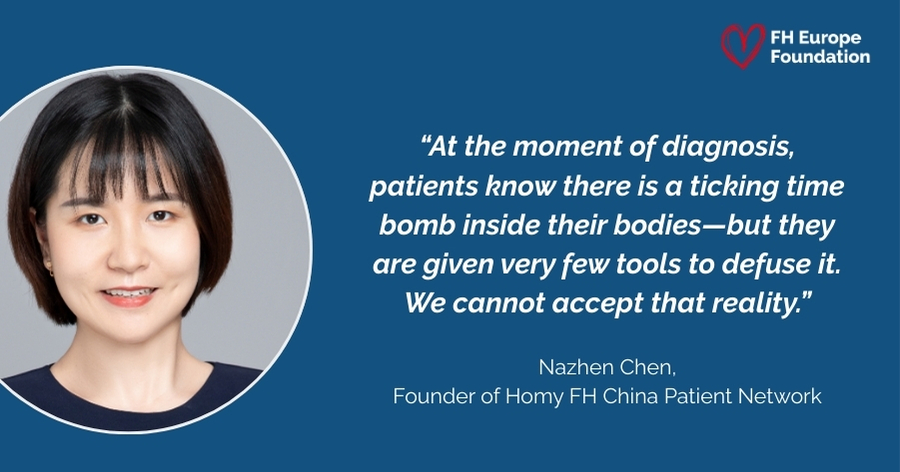
FH China’s connection with the FH Europe Network began even before formal membership. They participated in the 2024 Annual Network Meeting in Vienna and the 2025 Meeting in Zagreb, where Jenna presented on FH China’s work, challenges, and aspirations. These engagements cemented the alignment between FH China’s mission and FH Europe’s values, emphasising the importance of international collaboration in research, policy, and patient engagement.
Through the Network, FH China aims to:
Their membership brings fresh energy to the Network, enhancing diversity, cultural insight, and research collaboration. With links to clinicians like Dr. Chu, opportunities emerge for joint workshops, knowledge exchange, and bridging global research efforts, particularly in HoFH and emerging Lp(a) therapies. Their work on Mandarin-language awareness tools and localisation of FH Europe resources will make the Network more globally relevant and inclusive.
As part of the FH Europe Foundation, FH China will benefit from shared expertise across more than 30 patient organisations, including high-level policy guidance, participation in international advocacy initiatives, support for communication campaigns, and mentorship from organisations that have successfully influenced national FH policies.
Looking ahead, 2026 promises meaningful collaborations, including:
Together, we are building a global environment where people affected by inherited lipid conditions—no matter where they live—are supported, understood, and able to access the care they deserve.
We are proud to welcome FH China into the FH Europe Foundation Network. Their leadership, passion, and commitment will enrich our international community, and we look forward to many years of collaboration, learning, and impactful advocacy together.
Prepared by
Elsie (Cindy) Evans,
FH Europe Foundation Ambassador Programme Manager
December marked a milestone moment for FH Europe Foundation, closing an exceptional year of advocacy, collaboration and policy impact with the adoption of the European Safe Hearts Plan. From major EU-level developments to global engagement, patient leadership and research recognition, the month reinforced a shared commitment to prevention, early diagnosis and patient-centred cardiovascular care as the community looks ahead to 2026.
Catch up on the key highlights from the December 2025 edition of the Heart Beat newsletter:
On 16 December 2025, the European Commission published the first-ever EU Cardiovascular Health Plan, the Safe Hearts Plan, setting out a comprehensive and long-awaited European response to the leading cause of death and disability across the Union.
The FH Europe Foundation (FHEF), the European Atherosclerosis Society (EAS), and the Lp(a) International Task Force (Lp(a) ITF) warmly welcome this landmark initiative and commend the European Commission for placing cardiovascular health firmly at the centre of Europe’s public health, social and economic agenda.
Cardiovascular diseases affect around 62 million people in the EU, claim 1.7 million lives every year, and cost the European economy an estimated €282 billion annually¹. Without decisive action, the burden of cardiovascular disease is projected to rise by 90% by 2050, despite the fact that up to 80% of cardiovascular disease is preventable1,2.
“The Safe Hearts Plan clearly recognises that the most effective cardiovascular medicine is prevention. By embedding personalised, life-course approaches and addressing inherited risk, Europe now has a real opportunity to prevent disease before it starts, rather than treating its consequences decades later.” - Prof. Børge Nordestgaard, President, European Atherosclerosis Society.
The Safe Hearts Plan sends a clear and timely signal: Europe must move away from late intervention and crisis care, towards personalised, preventive, predictive, participatory and life-course approaches to cardiovascular health. By setting ambitious targets for 2035, including a 25% reduction in premature cardiovascular deaths, and by strengthening EU-wide collaboration on prevention, early detection, treatment and care, and quality of life, the Plan establishes a strong framework to protect both current and future generations3. This also means that the widespread practice of only conducting a first complete lipid and cardiovascular health profile at the age of 40+ should be abandoned, as this results in lost decades of prevention opportunities that can no longer be recouped.
Crucially, the Plan recognises that prevention cannot be “one-size-fits-all”. By integrating personalised prevention, supported by data, digital tools and artificial intelligence, it creates the conditions for more precise risk prediction, earlier intervention and more effective use of health system resources.
FHEF, EAS and Lp(a) ITF particularly welcome the Plan’s explicit recognition that cardiovascular risk is not only driven by lifestyle factors, but can also be genetic, lifelong, and present from birth.
Inherited lipid disorders affect an estimated 90 million people in the EU. Familial hypercholesterolaemia (FH) affects around 1 in 250-300 individuals, corresponding to approximately 2 million adults and 500,000 children, while elevated lipoprotein(a) [Lp(a)] affects around 1 in 5 people3.5. These conditions remain severely underdiagnosed and are major drivers of premature heart attacks, strokes, and aortic valve disease.
By explicitly acknowledging FH and elevated Lp(a), the Safe Hearts Plan marks a major step forward for families affected by inherited lipid disorders and reinforces the need to integrate genetic and lifelong risk into cardiovascular prevention strategies.
Importantly, the Plan also references EU-funded initiatives such as PERFECTO FH and FH-EARLY, underlining the importance of evidence-based, life-course prevention, universal paediatric screening for FH, social and behavioural science, personalised communication models, innovation in genetic testing and diagnostics, and the responsible deployment of digital and AI-enabled tools within trusted clinical pathways6,7.
The proposed EU Protocol on Health Checks for Cardiovascular Diseases is one of the most strategic elements of the Safe Hearts Plan and a key enabler of personalised prevention.
The priorities set out in the Safe Hearts Plan are strongly aligned with the work of the three organisations, which have long called for systematic, at least once-in-a-lifetime testing of lipoprotein(a) as part of comprehensive cardiovascular risk assessment. “This alignment reinforces the scientific consensus that early identification of elevated Lp(a) is a cornerstone of personalised cardiovascular prevention and should be done in context with the other common risk factors such as high LDL cholesterol, hypertension, obesity, diabetes and family history in the sense of a global cardiovascular risk assessment.” – Prof. Florian Kronenberg, Chair of the Lp(a) ITF.
EAS, Lp(a) ITF, and FHEF strongly believe that this protocol offers a major opportunity to prevent the vast majority of avoidable cardiovascular events, provided it fully capitalises on the Commission’s prevention-first and life-course vision. Health checks must move beyond adult-only approaches, identify risk before disease, and support timely, tailored interventions based on individual and familial risk profiles.
If Europe is serious about preventing up to 80% of avoidable cardiovascular disease, prevention—and therefore screening—must begin in childhood, while being combined with adult testing to deliver rapid and sustained population-level impact.
Early-life screening is the only effective way to detect familial hypercholesterolaemia and elevated Lp(a) in time to prevent decades of cumulative arterial damage5,8. It also enables the early identification of rare but life-threatening conditions, such as homozygous FH (HoFH) and familial chylomicronaemia syndrome (FCS), and supports family-based cascade and reverse-cascade testing, protecting entire families across generations.
“Heart disease as a result of undiagnosed FH changed my family’s life. The risk was detected simply too late. The Safe Hearts Plan gives future families something we didn’t have—the chance to know early, act early, and prevent avoidable heart attacks and strokes.” Lena Rosa Hanauer, FHchol Austria, FHEF Youth Group Ambassador and Secretary of the FHEF Patient Council.
Early screening further allows for the identification of related conditions, including type 1 diabetes (T1D), which has a similar prevalence to FH, within a holistic cardiometabolic framework. Most importantly, it creates a window of opportunity to support healthy behaviours from childhood, fully aligned with the Commission’s ambition to give European children and families truly safe hearts and so much more.
Decades of scientific evidence, clinical guidelines, and health-economic studies demonstrate that paediatric lipid screening is effective, timely and cost-saving, with a proven return on investment9,10. It is already recognised as an EU Best Practice and is reflected in the Prague Declaration on FH, the Brussels International Declaration on Lp(a) Testing and Management, and European clinical guidelines4,5,11.
In line with the Safe Hearts Plan, and building on the Commission’s vision for personalised prevention, EAS, Lp(a) ITF, and FHEF stand ready to support the development of an EU Protocol on Cardiovascular Health Checks that integrates early-life screening into a coherent life-course approach.
Such a protocol should include systematic lipid screening for children in the first decade of life, integrated into existing child health and vaccination programmes; measurement of a full lipid profile including LDL cholesterol, Lp(a) and triglycerides; family-based cascade and reverse-cascade testing; and seamless integration with adult cardiometabolic health checks.
Digital tools and artificial intelligence, aligned with the European Health Data Space, should be used to support risk prediction and personalised prevention, while ensuring transparency, explainability and clinician-mediated decision-making, in line with patient trust and ethical standards.
This approach is fully aligned with findings from Commission co-funded projects, including PERFECTO FH and FH-EARLY, and supports the Plan’s objectives to reduce inequalities, improve outcomes and strengthen health system sustainability.
The Safe Hearts Plan is part of a broader EU health policy package aimed at making Europe’s health sector more innovative, competitive, and resilient, alongside the proposed Biotech Act and the revision of the Medical Devices framework.
Together, these initiatives signal a clear strategic direction: accelerating innovation in prevention, diagnostics and treatment; enabling the responsible use of AI and data; strengthening European research and industry; and ensuring that patients across the EU benefit earlier and more equitably from scientific progress.
The Safe Hearts Plan creates a unique window of opportunity. Its success will depend on ambitious implementation by Member States, supported by EU coordination, funding, research and innovation.
FHEF, EAS, and Lp(a) ITF stand ready to work hand in hand with the European Commission, European Parliament, Council of the European Union, Member States, clinicians, scientists and people with lived experience to ensure that prevention truly starts early, health checks deliver maximum population impact, and no child or family is left behind due to late diagnosis.
“This Plan represents a turning point not only because it exists, but because of how it can be implemented. By embedding early detection, personalised prevention and co-creation with scientists, healthcare professionals, and equally with patients and citizens, Europe can translate innovation into real-world impact and prevent avoidable cardiovascular disease at scale.” Magdalena Daccord, CEO, FHEF.
By acting early, Europe can deliver on the promise at the heart of the Plan: safe hearts, healthier lives and a more resilient future.
Prepared by
 Magdalena Daccord,
FH Europe Foundation Chief Executive Officer
References