
The European Alliance for Cardiovascular Health (EACH) Summit, held in Brussels on December 11 to 12, brought together policymakers, clinicians, researchers, patient leaders, industry stakeholders, and life sciences representatives for two days of strategic dialogue aimed at accelerating progress against Europe’s leading cause of mortality: cardiovascular disease (CVD). The purpose of the Summit was clear: mobilise actionable momentum around the forthcoming EU Cardiovascular Health Plan, create alignment across sectors, and highlight the critical role of patient experience, innovation, and cross-domain collaboration in shaping a more resilient and equitable cardiovascular future. From prevention and early detection to health system redesign, the Summit served as a platform for collective commitment and concrete solutions.
A Programme Addressing the Urgent and the Essential
Across two days, the Summit covered a wide spectrum of priority themes, reflecting the complexity of cardiovascular health. High-level political leadership—including the European Commissioner for Health, Olivér Várhelyi and Members of the European Parliament—underscored the growing political will to tackle CVD at scale. Scientific sessions addressed environmental impacts on cardiovascular risk, mental health interactions, gender differences, and country-level examples such as Denmark’s national approach to CVD. Panel discussions explored inequalities, equity-oriented national action plans, and the competitiveness implications of cardiovascular health investment.
Day 2 deepened the focus on innovation, patient partnership, and system integration. The session Bridging the Innovation Gap emphasised the importance of co-creation with patients actively shaping, rather than passively validating, the design and implementation of health innovations. This set the stage for a robust discussion on patient leadership, followed by a cross-domain session exploring synergies, learnings and opportunities between Beating Cancer Plan and the upcoming cardiovascular health Plan.
FH Europe Foundation’s Contributions: Elevating Patient Voice and Multistakeholder Dialogue
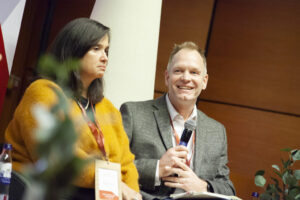
FH Europe Foundation (FHEF) played a significant role in shaping the Summit’s narrative and content. FHEF organised the session CVD and Cancer: Synergies, Learnings, Opportunities, and Challenges, moderated by Dr. Marius Geanta. Bringing together Penilla Gunther (EU Cancer Mission Board Member), Dr. Françoise Meunier (European Initiative on Ending Discrimination Against Cancer Survivors) and Dr. Catherine Paradis (WHO Regional Office for Europe), the panel established that meaningful progress in CVD can be accelerated by applying mature models from the cancer field, including coordinated care structures, survivorship frameworks, and strong patient advocacy ecosystems. This message resonated strongly across the Summit. The session demonstrated how closely aligned Europe’s cancer and cardiovascular agendas already are—and how much faster progress can be made by learning across them.

Drawing on the EU Cancer Mission, Penilla Gunther highlighted highly transferable insights on governance, clear goal-setting, and mission-oriented approaches, powerfully illustrating the untapped potential for a similar ambition in cardiovascular health. Catherine Paradis grounded the discussion in robust evidence, underscoring the role of commercial determinants of health and prevention policy levers, notably the shared impact of alcohol on both cancer and CVD and the practical relevance of WHO “best buys,” including the 3A approach.
Françoise Meunier brought a deeply human-centred perspective, emphasising survivorship, long-term outcomes, tobacco control, and the fundamental importance of the Right to Be Forgotten, arguing convincingly that these must be embedded as core pillars of health systems across disease areas. Together, the discussion reinforced that the forthcoming EU Cardiovascular Health (Safe Hearts) Plan can build decisively on existing cancer frameworks—without reinventing the wheel.
The recording of the session is available here.
FHEF’s commitment to embedding lived experience in policy conversations was also evident through Marc Rijken’s (FHEF Patient Ambassador and Member of the Lp(a) International Taskforce) participation in the Patient Voices in Action panel. Marc joined patient advocates living with diabetes, and cardiomyopathy and a stroke survivor, to present a compelling case for integrating patient experience into the very architecture of the EU Cardiovascular Health Plan. His testimony—highlighting how patient journeys can expose failures in system coordination, information flow, and multidisciplinary collaboration—reinforced the urgency of designing systems that work for real people navigating complex conditions.
Spotlight on PERFECTO: A Case Study in Applying Cross-Domain Best Practice
A highlight of the Summit was the reference to PERFECTO project, focused on improving the diagnostic and care pathways for individuals with inherited lipid disorders. PERFECTO embodies the Summit’s key message: progress comes from applying existing best practices rather than continually reinventing frameworks. The project draws on methods long established in cancer, including systematic screening, multidisciplinary management, and structured patient engagement, to address gaps in the lipid disorders pathway. Its inclusion at the Summit illustrated how cross-domain learning can translate into tangible system gains for cardiovascular care. This exemplifies an approach increasingly recognised as indispensable: identify proven models, adapt them to cardiovascular contexts, and scale them across Europe.
A Moment of Real Policy Momentum: Toward the EU “Safe Hearts” Plan
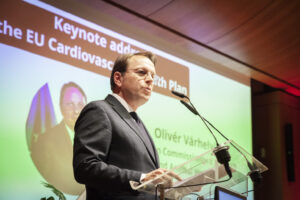
Held a week ahead of the EU CV Health Plan announcement, the event struck a powerful note that underscored the importance of political engagement. In his keynote address, European Commissioner for Health Olivér Várhelyi introduced the plan’s official name—Safe Hearts—and provided a first look at several of its anticipated priorities before its adoption on 16 December. The Plan will focus on scaling prevention and early detection, introducing cardiovascular health checks across all Member States, strengthening tobacco and nicotine products regulation, investing in AI-driven risk prediction, addressing gender-specific risk gaps, and improving outcomes for future generations.
This political commitment was reinforced by strong engagement from Members of the European Parliament, national government representatives, and international organisations throughout the programme. Their contributions reflected a growing consensus: cardiovascular health requires a unified, long-term EU strategy rooted in prevention, innovation, patient experience, and cross-disciplinary collaboration.
With this Summit, the cardiovascular community demonstrated readiness not only to support but to shape the implementation of the Safe Hearts Plan. The conversations made one thing unmistakably clear: Europe stands at a pivotal moment. By aligning existing best practices, elevating patient voices, and embracing cross-sector collaboration, Europe has the opportunity to usher in a transformative new era for cardiovascular health, one that finally matches the scale of the challenge.
Watch the highlights here: https://www.youtube.com/watch?v=QBgLrRC-m4I
Prepared by
 Dr. Marina Leroy,
FH Europe Foundation Scientific Communications Manager