
We are pleased to announce the publication of two major European Atherosclerosis Society (EAS) consensus statements:
Both statements were published simultaneously on 25 May 2026 and presented during a joint session at the EAS Annual Congress 2026 in Athens, Greece.
These landmark publications represent important advances in early detection, prevention, and lifelong management of inherited lipid disorders and cardiovascular disease.
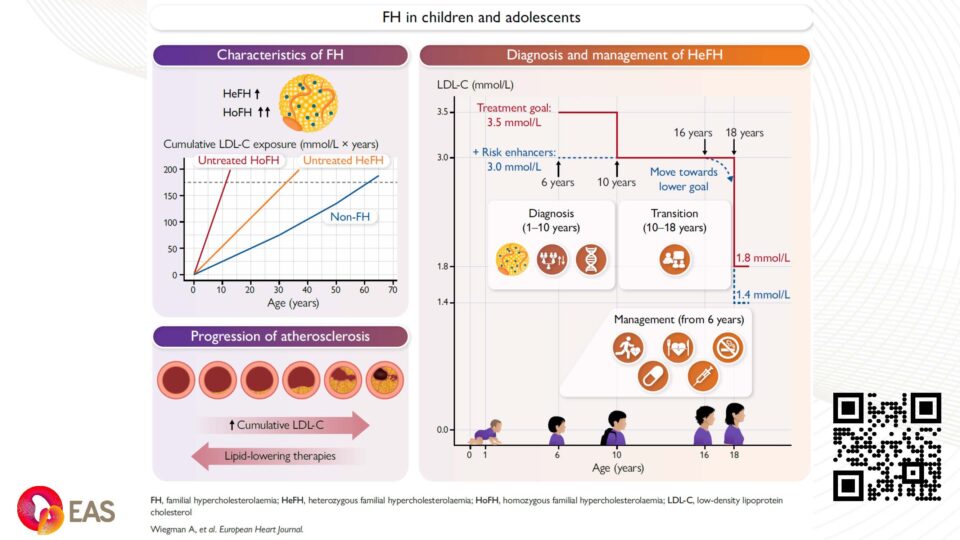
The new consensus statement highlights the need to improve the detection and management of familial hypercholesterolaemia (FH) in children and adolescents. The panel proposes widespread paediatric screening, earlier treatment, and updated approaches to diagnosis and care.
FH is a common genetic disorder characterised by lifelong elevated low-density lipoprotein cholesterol (LDL-C), which increases the risk of premature atherosclerotic cardiovascular disease (ASCVD). FH occurs in two forms: Heterozygous FH (HeFH), affecting approximately 1 in 300 people worldwide, and the rarer Homozygous FH (HoFH), affecting around 1 in 300,000. Individuals with HoFH, if untreated, are at extremely high risk of cardiovascular complications, already in childhood.
In the decade since the 2015 EAS consensus statement on FH in children, knowledge of the pathogenesis of FH has increased markedly, and a wider range of LLTs is now available (although access and reimbursement remain country-specific). This updated EAS consensus statement, co-chaired by professors Albert Wiegman and Jeanine Roeters van Lennep, provides revised diagnostic criteria, updated LDL-C treatment goals, and practical guidance on managing FH in children and adolescents. It emphasises the importance of starting LLTs early, ideally from the age of 6 for children with the HeFH and from the time of diagnosis for the children with the HoFH, and provides treatment algorithms for both HeFH and HoFH. The statement also addresses the transition to adult care and implementation strategies.
What is new in this EAS consensus statement?
Over the past decade, major advances in understanding FH have been accompanied by the development of a broader range of LLTs. Despite this progress, FH remains underdiagnosed and undertreated, particularly in children where it is rarely identified despite being one of the most common inherited conditions. “This is a missed opportunity, because we now have highly effective treatments that can normalise cholesterol levels and prevent cholesterol from accumulating in the arteries when started early in life.” says Co-Chair of the consensus and Trustee of FH Europe Foundation, Prof. Albert Wiegman (Netherlands).
Broader cardiovascular health implications
This important consensus statement comes at a very timely moment, following the announcement of the EU Safe Hearts Plan, where significant emphasis is being placed on cardiovascular health (CVH), early prevention, child health, and screening. With the recent call for evidence for cardiovascular health checks, the publication marks another important and highly practical set of evidence-based clinical recommendations for tackling cardiovascular disease (CVD) from early in life.
To address gaps in diagnosis, the EAS consensus panel proposes updated diagnostic criteria aimed at improving detection rates in younger populations. The panel also encourages all countries to establish paediatric screening programmes for FH.
Systematic screening approaches, including family cascade screening and universal paediatric screening in the first decade of life, have been shown to improve detection rates and to be cost-effective, but are not consistently used worldwide. “We cannot rely on chance diagnosis in adulthood,” says Co-Chair of the consensus and Scientific Advisor of FH Europe Foundation, Prof. Jeanine Roeters van Lennep (Netherlands). “Systematic screening is essential to find children with FH early and intervene effectively.”
Furthermore, the paper recommends testing for lipoprotein(a) [Lp(a)] in all children with suspected FH at the same time as paediatric screening, but not before 5 years of age.
We are delighted to share that Magdalena Daccord, FH Europe Foundation’s CEO, was one of the reviewers of the consensus statement.
Read:
Atherosclerotic cardiovascular disease (ASCVD) remains the leading cause of death worldwide, responsible for one in three deaths globally. Despite major advances in lipid testing, preventive therapies, and international treatment guidelines, implementation of optimal lipid management remains highly uneven across countries and healthcare systems.
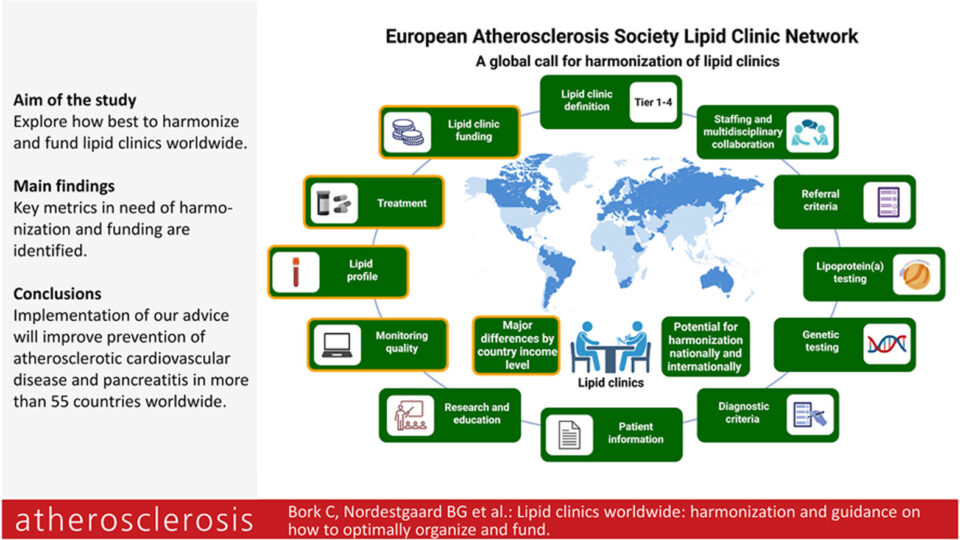
Lipid clinics offer specialist care to patients at highest ASCVD risk and with rare lipid disorders. They play a key role in increasing and improving education about lipid disorders among other healthcare professionals, in organisation of national registries, and in promoting awareness of the societal benefits and reduced costs of improving prevention of ASCVD. The EAS-Lipid Clinic Network has been established so that lipid clinics from all over the world can work together to tackle shared challenges and learn from mutual exchange.
This new consensus statement from the EAS Lipid Clinic Network, involving more than 500 lipid clinics in 55 countries, highlights one of the LCN's main aims - the need to harmonise the diagnosis and management of lipid disorders globally.
Co-chair of the statement, Dr Christian Bork (Denmark) said: ‘We identified major differences between clinics, nationally and internationally, in the delivery of guideline-recommended patient care. While almost all clinics followed guidelines, there were issues with implementation, especially for diagnostic testing, treatment and follow-up. We have excellent evidence-based guidelines on dyslipidaemia, and developing more guidelines is not the answer. Instead, we need to focus on how we organise and operate lipid clinic networks to ensure harmonised patient care, adapting to the realities of access and funding across different regions.’ Co-chair and EAS President, Prof. Borge G. Nordestgaard (Denmark) added: ‘Harmonisation is crucial to ensure optimal patient care, and ultimately to reduce the burden of preventable cardiovascular events such as heart attacks and strokes.’
Based on the 2024 EAS Lipid Clinic Network survey, the paper identifies several key areas for improvement, including increased education nationally and internationally, harmonisation of clinic organisation and treatment, guidance on staffing, development of national registries, and structured dialogue with governments to support funding and reduce the healthcare burden of ASCVD.
The consensus marks an important milestone for the clinical and patient communities by prominently including lived experience and a patient perspective. Elsie Evans, FH Europe Foundation Ambassador Programme Manager and a person living with HoFH, has been involved right from the beginning as an author of the publication.
The consensus statement provides practical recommendations for establishing well-functioning lipid clinic networks, including standards for diagnosis, treatment, multidisciplinary collaboration, education, and funding, with a particular focus on improving care in regions with high cardiovascular burden.
Read:
Together, these two EAS consensus statements reinforce the urgent need for a life-course, systems-based approach to cardiovascular prevention, from early screening and detection in childhood to equitable access to specialised lipid care across healthcare systems. They represent an important step towards reducing the burden of preventable cardiovascular disease worldwide.