
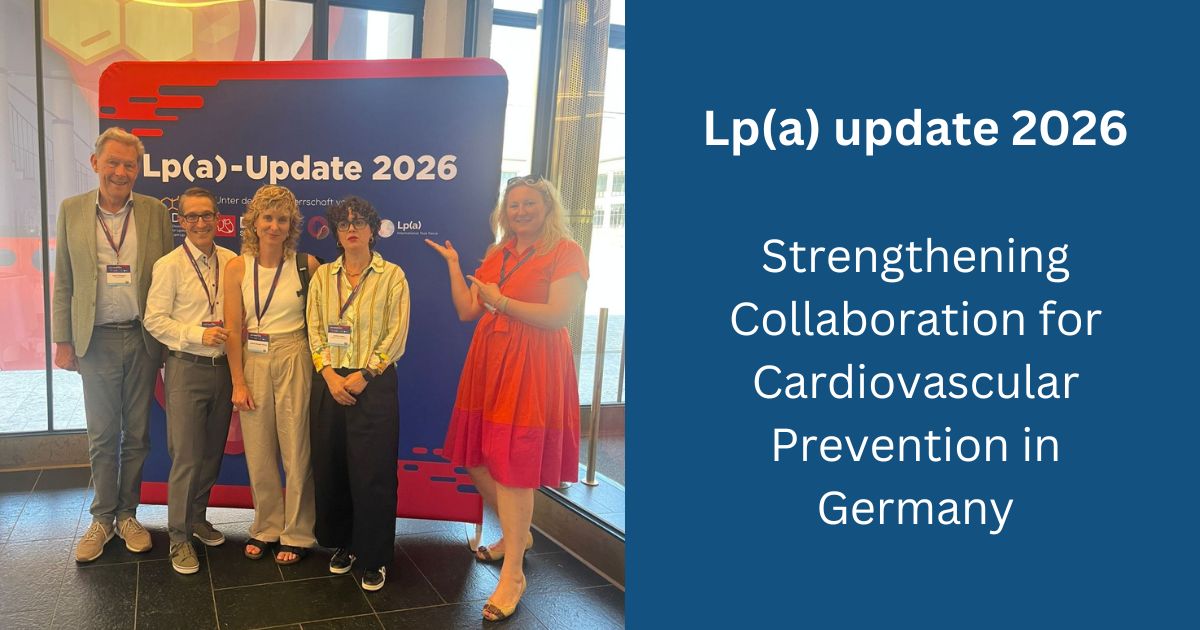
The Lp(a) International Task Force (ITF) and FH Europe Foundation (FHEF) were delighted to participate in Lp(a) Update 2026 organised by the German Society for Lipidology (DGFL – Lipid-Liga). The event took place in Munich, on 26 and 27 June, 2026. Bringing together leading national and international experts, the two-day meeting provided an outstanding platform for scientific exchange, collaboration and implementation, focusing on the latest developments in Lp(a) testing, risk assessment, imaging, prevention, lipoprotein apheresis and emerging therapies.
One of the most significant outcomes of the meeting was the strengthening of collaboration between the Lp(a) International Task Force and the DGFL. As Germany prepares to further integrate Lp(a) into cardiovascular prevention, this partnership reflects a shared ambition to move beyond scientific evidence towards practical implementation.
The meeting brought together clinicians, researchers, health economists, policymakers, implementation experts and people with lived experience, creating a unique opportunity to discuss how evidence can be translated into routine clinical practice and national prevention strategies.
For the Lp(a) International Task Force, this represents exactly the type of collaboration envisioned when the initiative was established—to bring international expertise together with national leadership, supporting countries in developing their own pathways towards earlier detection and better cardiovascular health.
The congress opened in an unconventional—but powerful—way.
Instead of starting with epidemiology, laboratory science or emerging therapies, the opening session focused on people.
Moderated by Magdalena Daccord, FH Europe Foundation Ambassadors Tobias Silberzahn (Germany) and Corinna Zangerl-Falkeis (Austria) shared two very different journeys with elevated Lp(a). Their conversation, moving naturally between English and German, combined scientific discussion with authentic personal experiences and even moments of humour, creating an engaging and memorable start to the congress.
Tobias described how, despite being healthy, physically active and passionate about prevention, he only discovered his elevated Lp(a) after hearing about it on a health podcast and insisting on being tested. His story highlighted the importance of health literacy, self-advocacy and, above all, early detection.
Corinna shared a contrasting journey. Despite maintaining a healthy lifestyle, she experienced serious cardiovascular disease before learning about her elevated Lp(a). Her reflections on shared decision-making, trust in her healthcare team, treatment with lipoprotein apheresis, quality of life and personalised care reminded the audience that medicine is about caring for the individual—not simply treating a disease.
Together, their stories reinforced one important message:
Earlier detection creates opportunities and choices.
The session also illustrated why the FH Europe Foundation established its Ambassador Programme and why the Lp(a) International Task Force continues to bring together scientists, clinicians, policymakers, implementation experts and people with lived experience. Science provides the evidence; people help ensure that evidence reaches clinical practice.
The scientific programme reflected the remarkable progress being made in the field of Lp(a).
A keynote lecture by Prof. Pia Kamstrup provided a clear and practical overview of why Lp(a) should be measured at least once in a lifetime, demonstrating how a single measurement can improve cardiovascular risk assessment long before disease develops. Particularly reassuring was the presentation of new research demonstrating no association between elevated Lp(a) and dementia, addressing an important concern frequently raised by both healthcare professionals and the public.
Members of the Lp(a) International Task Force also made significant contributions throughout the meeting.
Prof. Florian Kronenberg outlined the implementation priorities of the Brussels International Declaration on Lp(a), emphasising that the challenge is no longer generating evidence but translating existing knowledge into healthcare policy and routine clinical practice.
Prof. Zanfina Ademi presented compelling health economic evidence demonstrating that one-time Lp(a) testing is not only clinically valuable but also represents a cost-effective strategy for preventing cardiovascular disease, including within the German healthcare setting.
Prof. Albert Wiegman reinforced the importance of identifying elevated Lp(a) early in life, particularly alongside familial hypercholesterolaemia (FH) screening, creating opportunities for family-based prevention across generations.
Across both days, one message emerged consistently:
The evidence is now sufficiently strong to support broader implementation of one-time Lp(a) testing as part of cardiovascular prevention.
With the forthcoming Council Recommendation on Cardiovascular Health Checks, the Safe Hearts Plan, and increasing political attention to cardiovascular health across Europe, Germany is well positioned to become a leader in integrating Lp(a) into routine prevention strategies.
Beyond the scientific sessions, Lp(a) Update 2026 offered a rare and valuable opportunity to connect directly with the wider German lipid community.
The meeting brought together cardiologists, lipidologists, specialist nurses, researchers, representatives from the pharmaceutical industry, lipoprotein apheresis providers and medical technology companies, creating an ideal environment for collaboration and knowledge exchange.
For the FH Europe Foundation and the Lp(a) International Task Force, these conversations provided valuable insights into the German healthcare landscape and the opportunities and challenges associated with implementing routine Lp(a) testing.
The broader programme also highlighted the interconnected nature of inherited lipid disorders, with discussions extending beyond Lp(a) to include familial hypercholesterolaemia (FH), homozygous familial hypercholesterolaemia (HoFH)and familial chylomicronaemia syndrome (FCS). This broader perspective reinforced the importance of integrated approaches to lipid disorders and highlighted opportunities for collaboration across disease areas.
Another valuable aspect of the meeting was the opportunity to explore patient education initiatives already developed in Germany. Collecting examples of local patient information materials, educational resources and awareness campaigns will provide inspiration for future activities of the FH Europe Foundation Ambassador Programme and support the development of national implementation initiatives through the Lp(a) International Task Force.
Lp(a) Update 2026 demonstrated that successful implementation is built on more than strong scientific evidence. It requires partnerships, shared learning, trust and a common commitment to improving cardiovascular health.
The strengthened collaboration between the DGFL, FH Europe Foundation and the Lp(a) International Task Force represents an important step towards supporting Germany's ambitions in cardiovascular prevention. As Europe moves forward with the Safe Hearts Plan and the forthcoming Council Recommendation on Cardiovascular Health Checks, there is a unique opportunity to ensure that one-time Lp(a) testing becomes an integral component of routine cardiovascular risk assessment.
The FH Europe Foundation and the Lp(a) International Task Force extend their sincere thanks to the DGFL – Lipid-Liga, all speakers, industry partners and participants for their warm welcome, inspiring discussions and commitment to advancing cardiovascular prevention through collaboration, science and implementation.
Munich reminded us that while science generates the evidence, implementation happens through people and partnerships.