
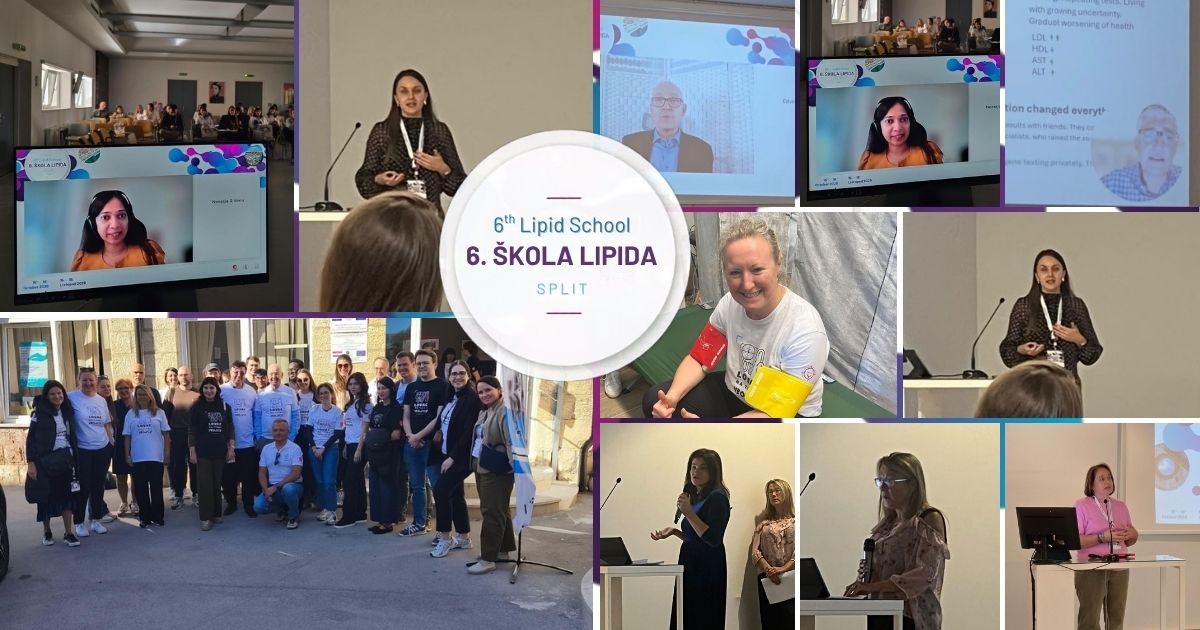
From scientific lectures to community health checks, FH Europe Foundation Ambassadors helped connect the latest evidence in lipidology with the realities of living with inherited lipid disorders.
What happens when people living with inherited lipid disorders and their caregivers are invited not simply to attend a scientific meeting, but to become part of its educational programme alongside leading international experts? At the 6th Lipid School in Split, Croatia, FH Europe Foundation (FHEF) witnessed a remarkable example of meaningful patient involvement in medical education. For the first time, FHEF Patient Ambassadors were integrated as speakers throughout the scientific programme, bringing lived experience directly into discussions on inherited lipid disorders alongside leading clinicians and researchers.
Organised by the Croatian Atherosclerosis Society of the Croatian Medical Association, the School took place from 15 to 18 October 2026 at the Mediterranean Institute for Life Sciences. It brought together almost 60 participants, including international medical and pharmacy students, young researchers and clinicians, and renowned Croatian and international experts in lipidology, cardiovascular prevention, diabetes, obesity and cardiometabolic health. Among the faculty were several members of FHEF's Scientific Advisory Committee and long-standing scientific collaborators.
The organisers deserve particular recognition for embracing patient expertise as an integral part of medical education. FHEF Ambassadors contributed in person and through prerecorded presentations, sharing their experiences of living with heterozygous familial hypercholesterolaemia (HeFH), homozygous familial hypercholesterolaemia (HoFH), elevated lipoprotein(a), familial chylomicronaemia syndrome (FCS) and lysosomal acid lipase deficiency (LAL-D), including the perspective of a parent and caregiver.
The scientific sessions addressed the latest evidence, diagnostic approaches, clinical guidelines and emerging treatments. The Ambassadors complemented this knowledge with something that cannot be found in clinical trials, laboratory results or treatment algorithms alone: the realities of everyday life. They spoke about delayed or missed diagnoses, the impact of inherited conditions on families, the challenges of managing treatment over a lifetime, the emotional burden of uncertainty, the importance of accessible and understandable information, and the hopes and expectations people bring to their healthcare. Their contributions were personal, sometimes emotional, always authentic, and offered a wider perspective on what it means to live with an inherited lipid condition.
For future clinicians and researchers, these are important lessons. Knowing how to diagnose or treat a condition is essential. Understanding the person who lives with it is equally important.
The programme provided a particularly valuable opportunity to connect individual experiences with the scientific subjects being discussed.
In the session “Lp(a): From Risk to the Patient”, Neeraja R. Venu, FHEF Lp(a) Ambassador, shared her perspective alongside scientific presentations addressing cardiovascular risk, laboratory diagnosis and management. Her contribution reinforced why identifying elevated Lp(a) is not simply a matter of obtaining a laboratory result. People need to understand what that result means for their health, their families and the decisions they may face throughout life.
The session “HeFH: Find Early, Treat Early” brought together clinical discussions on cardiovascular risk and national screening approaches with a patient contribution from Edwin Kaal, FHEF HeFH Ambassador. His lived experience helped connect the importance of early identification with the practical realities of diagnosis, family screening, treatment and long-term care.
The Lipid School also provided an important opportunity to explore rare and complex inherited lipid disorders. Bringing together people living with, or caring for someone affected by, three exceptionally rare inherited conditions – HoFH, FCS and LAL-D – created a unique learning opportunity. With prevalence estimates varying considerably across these conditions, many healthcare professionals may rarely encounter affected individuals in clinical practice, let alone hear their experiences together in one scientific programme.
During the session dedicated to FH screening and prevention, Elsie Evans, FHEF HoFH Ambassador, shared her perspective on living with one of the most severe forms of inherited hypercholesterolaemia. Her contribution highlighted the importance of early diagnosis, timely access to specialist care and appropriate treatment, as well as the realities of managing a serious inherited condition throughout life.
During the session on triglycerides, residual cardiovascular risk and cardiometabolic disease, Sabina Škorić and Michelle Sibley shared their experiences in a joint contribution entitled “How FCS Has Shaped My Life.” Following the scientific presentation on FCS , they brought the discussion back to the practical and emotional realities of living with FCS. For people affected by this rare condition, managing health can require constant attention to food, daily routines and the consequences of severe hypertriglyceridaemia, including the risk of acute pancreatitis. The effects extend well beyond clinical measurements, influencing family life, relationships, social activities and emotional wellbeing.
Eduardo López, LAL-D patient advocate, complemented the scientific presentation on lysosomal acid lipase deficiency with his experience as a father and caregiver of a child diagnosed with this rare condition. Often confused with FH, mixed dyslipidaemia or more common liver conditions, LAL-D can be challenging to diagnose. Eduardo described the lack of information and support his family faced and how this inspired him to establish a patient organisation to help others navigating similar challenges.
Together, these Ambassador contributions demonstrated why rare and complex lipid disorders must be considered beyond laboratory values alone. They highlighted the importance of listening to patients and caregivers, recognising atypical presentations, improving diagnostic pathways and ensuring that scientific progress translates into timely, personalised and equitable care.
Patient involvement was also central to the session “Policy, Advocacy & What Can We Do?” Iva Prgomet, representing the Croatian Association of Patients with Dyslipidaemia, presented “From a Personal Story to a Movement for Health”, demonstrating how lived experience can become a powerful force for awareness, education and community mobilisation. Magdalena Daccord, CEO of FH Europe Foundation, followed with “The Role of Patients in Making Inherited Lipids Part of the Safe Hearts Plan.” Her presentation explored how patient organisations and advocates have contributed to bringing inherited lipid disorders, including FH and elevated Lp(a), into European cardiovascular health policy.
Drawing on FHEF's work in paediatric FH screening, the Prague Declaration, the Brussels International Declaration on Lp(a), European research collaborations and sustained engagement with policymakers, she highlighted the role of patient advocacy in connecting scientific evidence, public health priorities and real-world needs.
The central message was clear: patients are not only beneficiaries of better policies. They are partners in shaping them and in making sure they translate into meaningful improvements in people's lives.
For FHEF, the Lipid School was also an opportunity for Ambassadors to learn from leading experts, explore the latest science across lipidology and cardiometabolic health, and build relationships with clinicians, researchers and fellow advocates. Their participation required courage, preparation and commitment, while offering invaluable opportunities for mutual learning. Patient Ambassadors are experts in their lived experience, and scientific meetings help strengthen their knowledge and advocacy skills, while inspiring future healthcare professionals to recognise patients as partners in care and research.
Beyond the lecture hall, the “Hunting the Silent Killer” campaign brought free cardiovascular health checks to the community of Hrvace, near Sinj. Participants and local healthcare professionals offered blood pressure and weight measurements, blood and urine tests for lipid and kidney health, ECGs, and aortic and vascular assessments. It was an opportunity to see screening and prevention in action, bringing our #KnowYourNumbers message directly to the community and demonstrating how scientific knowledge translates into practical public health initiatives.
Our sincere thanks to Prof. Ivan Pećin, Prof. Željko Reiner, the Croatian Atherosclerosis Society of the Croatian Medical Association, the Scientific and Organising Committees, the faculty, participants and local community. Above all, thank you to our FHEF Ambassadors for your courage, commitment and willingness to share your experiences, reminding us that behind every diagnosis and scientific advancement is a person and a family.
The 6th Lipid School demonstrated the value of bringing scientific expertise, lived experience, medical education and community prevention together. It created opportunities for mutual learning across conditions, disciplines and generations, while reinforcing the importance of meaningful patient involvement. We need more opportunities like this – and more Ambassadors in Action!