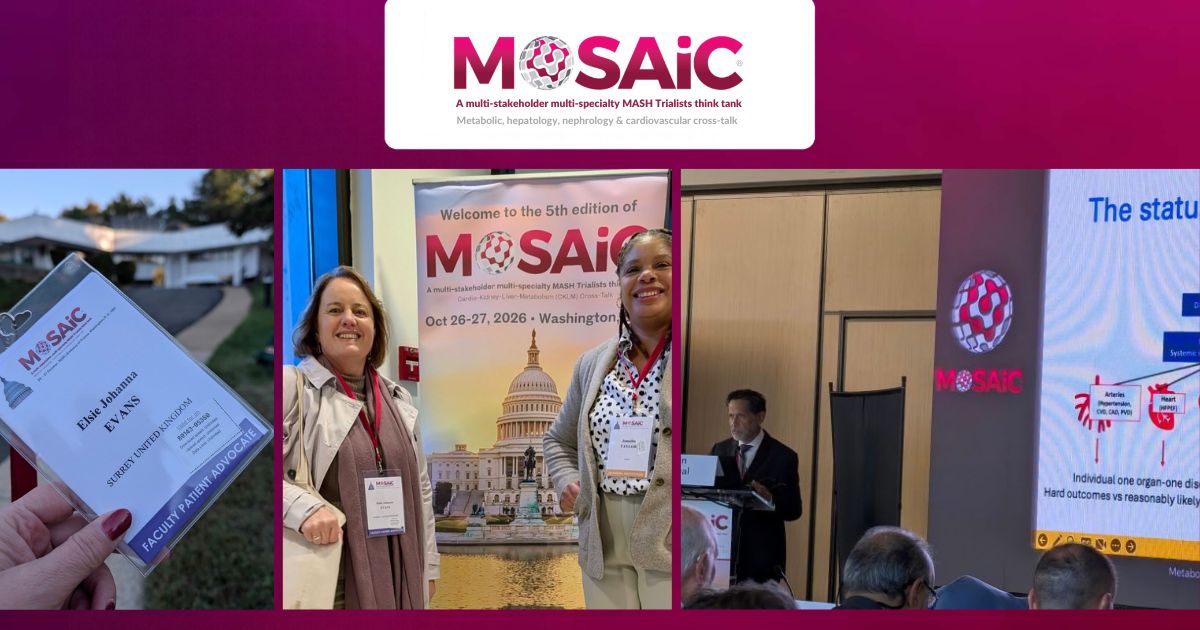
Reflections from Elsie Evans, Patient Ambassador representing the FH Europe Foundation community
On 26–27 October 2026, specialists, researchers, regulators, industry representatives, journal editors and patient advocates came together at the MOSAIC NASH forum in Washington, DC. The aim was to explore how research can better reflect the connections between cardiovascular, kidney, liver and metabolic health, known collectively as CKLM. I attended as a Patient Ambassador representing FH Europe Foundation and co-chaired the Patients, Trial Participants and Patients’ Advocates Forum with Henry Chang from the Fatty Liver Foundation. Although the science was complex, the question I carried throughout the meeting was simple: Will this progress help people live longer, healthier and better lives?
Understanding the conditions being discussed
MASLD, or metabolic dysfunction-associated steatotic liver disease, happens when excess fat builds up in the liver alongside wider metabolic risk factors.
MASH, or metabolic dysfunction-associated steatohepatitis, is a more serious form of MASLD. It involves liver inflammation and damage and can lead to liver scarring, known as fibrosis.
However, these conditions do not exist in isolation. They are closely connected with cardiovascular disease, kidney disease, diabetes, weight and wider metabolic health. MOSAiC therefore focused on how clinical research can move beyond examining one organ at a time. This closely connects with the experience of the FH Europe Foundation community. People living with familial hypercholesterolaemia, homozygous familial hypercholesterolaemia, familial chylomicronaemia syndrome or elevated lipoprotein(a) are not simply managing a cholesterol or triglyceride result. We often have to deal with liver concerns due to condition or treatments, pancreatitis (FCS), etc as we are a connected being and everything we live with affects others parts of us. We are balancing cardiovascular risk, other health conditions, treatment, work, family responsibilities and uncertainty about the future.
'People do not experience their health as separate organs, specialties or clinical measurements. They experience one life.'
Setting the scene was Jeffrey Lazarus who opened the scientific programme with an update on the global burden of CKLM disease follow by Arun Sanyal who then reviewed the current MASH and MASLD trial landscape and considered how far it has progressed towards MOSAiC’s ambition for integrated, multi-organ research. This provided important context. Research has traditionally been divided by disease and medical specialty. A liver trial may focus on liver scarring, while a cardiovascular trial measures heart attacks or strokes and a kidney trial measures changes in kidney function. These measures remain important, but they do not always show the full effect of a medicine or reflect the complete health of the person taking it.
Can one treatment benefit several areas of health? Rohit Loomba, Faiez Zannad, Arun Sanyal, Philip Newsome and Naim Alkhouri examined different treatment strategies that could potentially provide benefits across the liver, heart, kidneys and metabolism. These included incretin-based medicines, liver-directed treatments, cardiorenal medicines, FGF21-based therapies and combinations of different medicines.
In simple terms:
- Incretin-based medicines act on natural hormone pathways involved in appetite, blood sugar and metabolism.
- Cardiorenal medicines are treatments intended to protect the heart and kidneys.
- FGF21-based medicines copy or enhance the action of a natural hormone involved in how the body manages fats, sugars and energy.
- Combination therapy means using two or more treatments together to address different parts of a condition.
These approaches are promising, but the discussions also brought necessary caution. An improvement in a scan, blood test or other biological measurement does not automatically mean that people will feel better, avoid serious complications or live longer.
Risk reduction or genuine disease modification?
A major discussion chaired by Javed Butler and Jörn Schattenberg explored the difference between reducing risk and changing the course of disease. The session included perspectives from hepatology, cardiology, kidney medicine, endocrinology, industry, regulators and patients. Faiez Zannad, Jörn Schattenberg, Javed Butler, Amit Sharma and Jennifer Green considered what disease modification should mean across several interconnected areas of health. Henry Chang brought the patient viewpoint.
One message from Henry Chang, a fellow patient advocate, was particularly important: people living with MASH do not experience “histology”, meaning changes seen in liver tissue under a microscope. They experience how they feel each day and the outcomes they fear for their liver, heart and kidneys.
This challenges researchers to look beyond whether a medicine changes a laboratory result or tissue sample. We must also ask:
- Does it prevent serious complications?
- Does it improve how someone feels and functions?
- Is the treatment burden manageable?
- Can people access and continue the treatment?
- Are the benefits meaningful enough to justify the side effects, appointments and uncertainty?
Better tests with less burden and so several sessions examined how clinical trials could use biomarkers, imaging and other non-invasive tests. A biomarker is a measurable sign of what is happening in the body, such as a blood result or scan finding. These tools could reduce dependence on liver biopsy, where a sample of liver tissue is removed for examination. Biopsies can provide valuable information, but they are invasive and may create additional discomfort, anxiety and participation burden. Of course we already know the importance of early detection and precision medicine from our PerMedFH, FHEARLY projects.
The discussions highlighted the need for a prioritised set of cardiovascular, kidney, liver and metabolic measurements. Kidney function measures should be included more consistently, and more advanced tests should be used when they answer a clear clinical or scientific question. For patients, the purpose must be clear. A less invasive test is welcome, but it must still provide dependable evidence about whether a treatment is safe and beneficial.
Designing trials around real life brought another important theme was the practical challenge of running one clinical trial with outcomes across several organs. Trials attempting to measure every possible major outcome could require many thousands of participants and continue for several years. Researchers therefore discussed more realistic options, including:
However, efficiency should not come at the cost of relevance or representation. Selecting only very high-risk participants may make it easier to detect results, but the findings might not apply to the wider community. Trials must also recognise the realities of participation, including travel, time away from work, caring responsibilities, costs, fatigue, language, digital access and the emotional impact of living with uncertainty.
Real-world evidence, registries and trust filled the second day where we explored real-world evidence, meaning information collected outside traditional controlled clinical trials. This may come from routine healthcare, patient registries or long-term follow-up. Javed Butler, Nancy Dreyer, Ian Neeland and Shahzeb Khan considered which outcomes matter after a medicine is approved, how real-world information can support regulatory decisions and what would be needed to build a CKLM registry.
Registries can help researchers understand longer-term safety, treatment use and outcomes in more varied communities. However, their value depends on trust. All of the patient voices chimed in as one, data is 'owned by patients' but what does that really mean. One comment 'I was told that my data has value and the one who owns the data has the power', so is it not time that we truly discuss who owns the data but more so who accesses the data.
People should receive clear information about:
- why their data are being collected;
- who controls and can access the data;
- how the information will be used;
- whether it may be used for future research;
- and how findings will be returned to participants and communities.
Patients should help shape these arrangements before the systems are built, not simply be asked to contribute data afterwards. A great end of day question - should persons have the autonomy to add their own data to registries if they so choose.
Bringing the patient voice into the centre of the discussion was on the agenda and we made the most of it. During networking, dinner, breaks but also in the spotlight. The Patients, Trial Participants and Patients’ Advocates Forum brought together Gina Bartes, Michael Betel, Wayne Eskridge, Henry Chang, Patrick Gee, Marko Korenjak, Margaret Padilla and me.
Our discussion reinforced that research should be designed with people and around their lives.
Important priorities included:
Meaningful patient involvement is not measured by how many patients are invited into the room. It is measured by what changes because they were involved. We felt that a research team should be able to say: this is what we heard, this is what we changed, and this is what we could not change and why.
What stood out for the FH Europe Foundation community is that MASH and inherited lipid conditions are different and yet connected. Many of the questions discussed at MOSAiC are highly relevant to our community.
- Earlier action matters: Earlier identification and treatment may prevent serious disease. For our community, this reinforces the importance of earlier diagnosis, family screening, better risk awareness and timely access to appropriate care.
- Measurements must connect with meaningful outcomes: Cholesterol, triglycerides, scans and other biomarkers provide essential information. But people also need to know what a change means for their risk, their treatment choices and their daily lives.
- Care must become more connected: People may see several specialists, but communication between services is not always consistent. Connected care should include the patient as an active partner, not simply place more professionals around them.
- Treatment availability is not the same as access: A medicine can only improve health if people can obtain it, manage the treatment burden and continue taking it. Cost, side effects, travel, monitoring requirements and national differences in access all matter.
- Patient organisations have an important role: Patient organisations and Patient Ambassadors can help researchers understand community priorities, review study information, identify participation barriers, advise on meaningful outcomes and communicate results in language people can understand.
What happens next, as we closed the final MOSAiC sessions considered how the CKLM agenda can move from discussion into implementation. Biykem Bozkurt, Guillaume Baudry, Philip Newsome and Jennifer Taylor explored integrated frameworks, collaborative research programmes and how this work could be shared more widely. Journal editors also contributed their perspectives on communicating and publishing this developing evidence.
For the FH Europe Foundation, the next steps should include:
- sharing the learning with our Ambassadors and Network members;
- identifying people interested in research and trial-design discussions;
- developing simple explanations of CKLM, MASLD and MASH;
- building stronger links with liver, kidney, cardiovascular and metabolic patient communities;
- supporting researchers to involve patients earlier;
- promoting measures that reflect how people feel, function and live;
- and asking research partners to show what changed because of patient involvement.
A final reflection
I left MOSAiC encouraged by the scientific progress, but also aware of the work still needed. Integrated research should not simply add more tests or outcomes to a trial. It should help us understand the whole person more clearly while reducing avoidable burden.
The success of CKLM research will not be measured only by whether several organs can be included in one protocol. It will be measured by whether research becomes more relevant, participation becomes more accessible, care becomes more connected and people experience better health and better lives.
People do not live one organ at a time. Our research, healthcare systems and partnerships must begin to reflect that reality.
For more information about
MOSAIC NASH, its speakers and the full programme, visit the
MOSAiC website.